

Luoyang Dinghuang Mechanical Equipment Co., Ltd.: Boost production capacity with a single-cylinder hydraulic cone crusher—no need to rush; the methods and tips are right here!
Release time:
2026-07-27
As the industry’s “nemesis of hard rock,” the single-cylinder hydraulic cone crusher is widely used for crushing a variety of medium‑hard and hard materials. Since its introduction, it has been highly acclaimed by customers across the board and stands as one of the primary pieces of equipment for medium‑to‑fine crushing. Overall, the single-cylinder hydraulic cone crusher is a highly effective crushing solution; however, its production efficiency can vary significantly depending on the specific application. Consequently, enhancing its operational performance has become a shared priority for all stakeholders.
As the industry’s “nemesis of hard rock,” the single-cylinder hydraulic cone crusher is widely used for crushing a variety of medium‑hard and hard materials. Since its introduction, it has been highly acclaimed by customers across the board and stands as one of the primary pieces of equipment for medium‑to‑fine crushing. Overall, the single-cylinder hydraulic cone crusher is a highly effective crushing solution; however, its production efficiency can vary significantly depending on the specific application. Consequently, enhancing its operational performance has become a shared priority for all stakeholders.
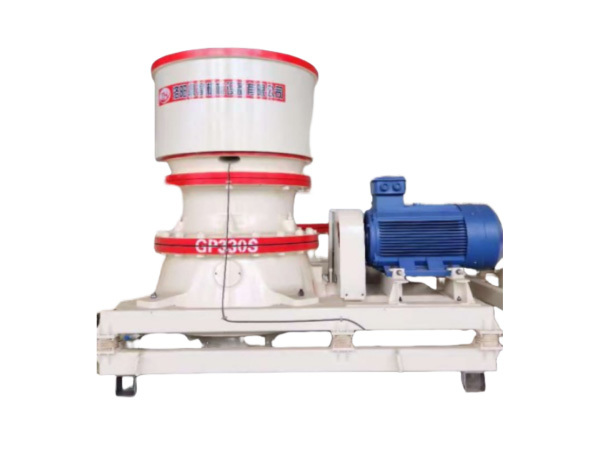
Based on Dinghuang Heavy Industry’s years of accumulated experience, the factors affecting the production capacity of a single-cylinder hydraulic cone crusher can be categorized into “internal” and “external” components. External factors are primarily related to the material being processed, while internal factors pertain to the machine itself and its operational use. Focusing on aspects directly linked to the equipment:
The rotational speed of the moving cone in a single-cylinder hydraulic cone crusher. The cone’s rotational speed is one of the key factors affecting throughput: when the speed is too low, material slides along the moving‑cone liner as it passes through the crushing chamber, prolonging its residence time and reducing production efficiency; conversely, if the speed is too high, material struggles to discharge downward, leading to post‑crushing buildup and potential blockages.
The bottom angle of the moving cone. This angle determines the inclination of the moving cone: a larger bottom angle facilitates free-fall motion of the material, but reduces the number of crushing impacts as the material passes through the crushing chamber, resulting in higher throughput at the expense of reduced product quality. Conversely, when the bottom angle decreases, the surface of the moving cone becomes more gently sloped, causing the material to fall along the liner of the moving cone; production output declines, while the quality of the crushed product improves.
The influence of the precession angle. The magnitude of the precession angle directly determines the eccentricity and the swing stroke of the discharge opening in a cone crusher. When the precession angle is large, both the eccentricity and the swing stroke of the discharge opening increase, allowing material to fall more readily and thereby boosting throughput; however, this also reduces the number of times the material is subjected to crushing within the crushing chamber, leading to a decline in product quality. Conversely, as the precession angle decreases, the eccentricity and the swing stroke of the discharge opening diminish, resulting in longer residence times for the material in the crushing chamber, which lowers throughput but enhances crushing efficiency and improves product quality.
The material fill rate. Material filling is closely related to the throughput of a single‑cylinder hydraulic cone crusher: when the fill rate is low, the material fails to fully occupy each crushing zone, resulting in reduced output; conversely, at high fill rates, the material becomes overly compacted, which hinders laminated crushing and impedes its passage through the crushing chamber, ultimately leading to lower throughput and poorer product quality.
Based on years of practical field experience, increasing the production capacity of a single-cylinder hydraulic cone crusher primarily involves addressing the following aspects:
During feeding, strive to keep the crushing chamber consistently full. Feeding only small amounts will not reduce the load on the cone crusher; on the contrary, insufficient material not only lowers throughput and degrades product shape but also places significant stress on the bearings of a single‑cylinder hydraulic cone crusher. In general, the actual operating power of a single‑cylinder hydraulic cone crusher should not fall below 40% of its rated power. If the feed rate fluctuates—sometimes too much, sometimes too little—the product’s particle shape and yield will become unstable. This is especially true for cone crushers operating with a partial cavity, where the product’s gradation and flakiness will both be suboptimal.
Perform regular maintenance on the liners. In a single‑cylinder hydraulic cone crusher, the liners comprise the mantle and the bowl liner; excessive wear can compromise the machine’s crushing performance, making routine liner inspections essential. Inspection should focus on several key indicators: if the crusher’s throughput has noticeably declined, or if the liner thickness has thinned or developed cracks, these signs indicate damage. Conduct periodic wear checks by taking four measurements around the crushing chamber to identify any uneven wear; if such irregularities are detected, make timely adjustments.
Lubrication system maintenance: Ensure adequate oil levels—sufficient quantity is essential to lubricate all components—and maintain clean oil quality. Regularly and thoroughly inspect the oil pump’s operation, paying particular attention to avoid excessive temperature rise. Periodically clean the oil‑water separator and check all filter elements; also examine the return‑oil strainer for copper filings. The presence of such filings indicates varying degrees of wear or damage to the bearing bronze liners.
The single-cylinder hydraulic cone crusher boasts outstanding performance. Just as a sword requires regular polishing, this equipment demands diligent maintenance and proper, prudent operation to ensure sustained productivity.
Key words:
Learn more about industry dynamics
A mining machinery manufacturing enterprise that mainly produces crushing and screening machinery, integrating R & D, design, processing, manufacturing, sales and after-sales service.



Focus on crushing and screening machinery industry solutions
58 Guangshen Road, Luoxin Park, Economic and Technological Development Zone, Xin'an County, Luoyang City, Henan Province
Online message
We will contact you within one working day. Please pay attention to your phone or email.